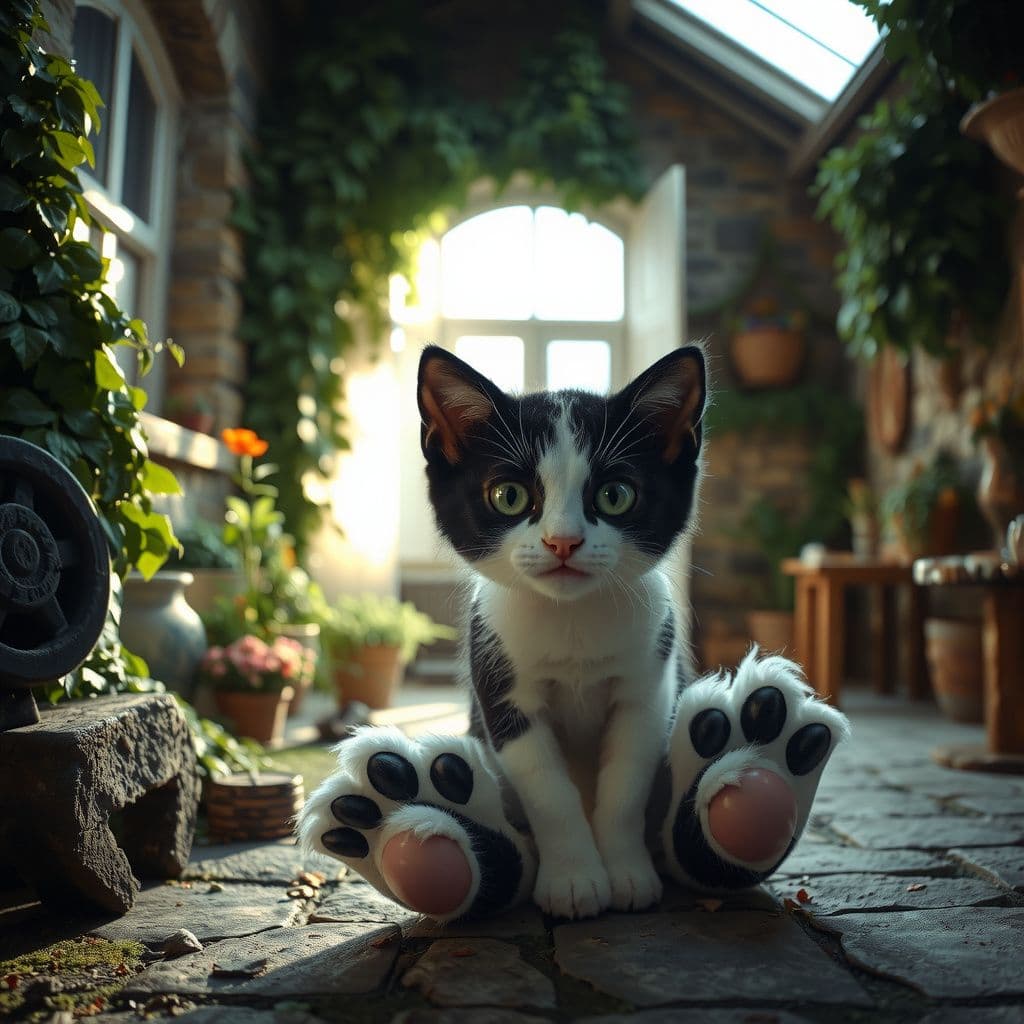
The Day We Met Pickle
After a long, borderline soul-eroding, dignity-stripping pursuit of finding a cat, we finally found him. Pickle. You’d think acquiring a small, mildly judgmental mammal would be straightforward. It was last time. With Monkey, it all fell into place — quick, seamless, and suspiciously free of emotional damage. Message. Visit. Deposit. Done. He arrived like a well-ordered Amazon parcel with whiskers and mild trust issues. This time? Mayhem. Bureaucracy. Low-level psychological warfare. It’s like everyone and their entire extended bloodline has suddenly decided they need a cat. Ads appear and vanish quicker than my will to meal prep on a Sunday evening after opening a bottle of wine — “just to take the edge off.” “Sorry, already rehomed.” “Gone.” “Reserved.” “Unlucky.” Or worse — nothing. A void. A black hole of unanswered messages where hope goes to die. And then, the other extreme. “Send deposit. Cat yours.” Ah yes. The classic Schrödinger’s Kitten. Simultaneously real and a scam. One woman — broken English, relentless urgency: “You send now. Many people want kitten. You too slow.” Too slow? Madam, I haven’t even seen the cat. For all I know I’m wiring money for a blurry photograph, a non-existent kitten, and a curse that follows me into 2027. It was a firm no. And then — like a divine intervention wrapped in decent grammar — the right person appeared. Responsive. Polite. Suspiciously competent. Human. Within five messages, we’d arranged to meet our new kitten. I almost didn’t trust it. Where was the chaos? The mild emotional trauma? The suspicious PayPal request? Still — we pressed on. Devon. About an hour and a quarter away. The kind of drive where anticipation sits in your chest like a fizzy drink shaken a bit too violently, teetering right on the brink of eruption. Pickle. Our Pickle. The sat-nav announces our arrival with all the emotional weight of a lifelong commitment I don’t fully understand but am apparently making anyway. And there it is. A cottage so picturesque it feels borderline offensive. Old stone. Ivy crawling the walls, clearly smitten. Not another house in sight. The kind of place where people say things like “we grow our own thyme now” and mean it. Enviable. We approach the door. I give it a confident ratta-tat-tat, because apparently that's what us responsible pet owners do. I’ve already briefed Mat. “Please. For the love of all things holy — behave.” He grins. “Top off?” “Absolutely not.” “But skin on skin—” “He’s a kitten, not a premature baby.” The door opens. And my stomach drops. I know that face. I would know that face in a burning building, across a motorway, or in the depths of hell itself. Aileen. From work. Miserable cow. The definition of an energy vampire — draining the life out of a room before she’s even fully in it. She stares at me like I’ve personally ruined her week — which, to be fair, may have happened once when I said ‘morning’ too cheerfully. She mutters something that could be a greeting or a low-level threat and gestures vaguely behind her. Enter: her son. Lanky. Curly-haired. Radiating the kind of warmth Aileen clearly hoards. “Come in,” he beams. “He’s waiting for you.” The house is stunning. Of course it is. Of course Aileen lives in a countryside dream while emotionally haunting the Royal Mail depot like a disgruntled spirit on a zero-hours contract. “Charlene, your house is incredible—” Silence. Oh no. Oh no no no. Aileen. Not Charlene. Aileen. Her eyes lock onto mine. If looks could kill, I’d already be buried under the patio — cracks filled, edges smoothed, job done. I move on swiftly, abandoning the sentence like it’s betrayed me, pivoting with the confidence of someone who definitely didn’t just say the wrong name. And there he is. Pickle. Except… Something’s off. His feet. They’re… enormous. Not just big — full-on scuba-diver flippers, slapping against the floor like he’s moments away from launching himself into open water. Maritime. Dock-ready. Absolutely not designed for carpet. I glance at the son. He laughs, just a touch too quickly. “He’ll grow into them.” Will he, though? Will he. Because right now he looks like a kitten fitted with the wrong feet. Still. He’s adorable. Black and white, with a tiny inky smudge on his nose like a misplaced fingerprint, big googly eyes, and a soft pink nose that gives him the faintly unhinged charm of Pinky from Pinky and the Brain. Friendly, curious, and flippered. We’re smitten. The journey home is accompanied by the soft, squeaky cries of a kitten trapped in a carrier he never agreed to. It’s heartbreaking. I spend most of the drive whispering reassurances like a lunatic. “You’re safe now.” “We love you.” “Please stop crying before I turn this car around and have a breakdown.” Back at home, Pickle settles almost immediately — suspiciously, unnervingly quickly — like he’s always been part of the madhouse. And it hits me — This is nothing like Monkey. When Monkey first came home, he vanished. Straight under the sofa. A self-imposed exile. Two full days of silence, broken only by the faintest rustle and the occasional, desperate dash for food when he thought no one was watching. We lay on the floor like wildlife photographers, whispering: “I think I saw an ear.” “No, that’s a shadow.” “Is he… breathing?” He was terrified of us. Of the house. Of existence itself. It took time. Patience. Quiet. Trust had to be earned. Pickle? Pickle waltzes in like he just stamped the mortgage papers with a gargantuan paw print and a smug smile. Monkey, however, takes one look at him — specifically, at those outrageous flippers — and simply… leaves. No hiss. No drama. Just: “No.” And off he goes, dignity intact. So much for my fantasy. The two of them, curled together. Grooming each other. Sharing meals like a wholesome pet food advert. Instead? Passive-aggressive coexistence. And Pickle? His flippers are a problem. He trips over them constantly, wobbling across the floor like a tiny scuba diver navigating a living room reef. He attempts to jump and lands with the subtle finesse of a rubber boot bouncing down the stairs. At one point, he misjudges completely and belly-flops both front flippers into his water bowl, then sits there blinking at them as if they’ve personally betrayed him. He tries to chase a toy mouse. The flippers have other ideas. Instead of a graceful pounce, he flails sideways, slides three feet, and comes to a dramatic halt — tail puffed, eyes wide, dignity shredded. By the time he climbs up to the attic room, I’m convinced these flippers have a mind of their own, plotting tiny acts of rebellion while maintaining a perfectly innocent facade. And there he is — Phoebe cradling him like a baby, his ridiculous feet sticking out like wayward paddles on a tiny, lost canoe. “I love him,” she says softly. And it is lovely. There’s something about it — seeing him finally calm, seeing her smile — that makes my chest ache in a quiet, unplaceable way. “Shall we take a selfie?” Ah. My personal hell. I avoid photos like the plague ever since that wedding — the one where I got so drunk I fell asleep at the bar and then had to be carted back to my tent in a trailer — yes, a trailer. Someone filmed it, posted it on Facebook, and it’s haunted me ever since. “Go on, Mum. Just a few,” Phoebe says, hopeful. So I sit beside her. We pose. Or… attempt to. I can’t find my smile. It’s either too tight, too forced, or hovering somewhere near visible distress. She takes them anyway. And together, we look. I nearly swallow my entire tongue in disbelief. That’s not me. It can’t be. Short, layered bob with sun-bleached highlights. Thin cardigan. Capris. Large, outdated sunglasses perched halfway down on my nose. Middle-aged. Frumpy. Jesus Christ… I’m a Karen. And oh my god — the wrinkles. So many wrinkles. I look haggard, exhausted. Older than I feel. Older than I’ve agreed to. Older than the version of me I’ve been quietly carrying around in my head. “Jesus… do I actually look like that?” Phoebe frowns. “What do you mean?” I stumble to the mirror. And there she is. Me. But not me. A version I don’t recognise. Or maybe one I’ve been refusing to. “You’ve always looked like that, Mum.” Her voice is gentle now. Careful. Concerned. My mind spins. “But I—“ Heavy footsteps thunder up the stairs. Mat bursts in. Top off, obviously. Because of course. But — He’s wrong too. Different face. Same voice. Like someone’s wearing him slightly off-centre, like a costume that almost fits but bunches at the shoulders. “What’s going on?” I whisper. Phoebe doesn’t answer. She just points. Pickle. I look down. His feet — They’re normal. Perfectly proportioned. Neat. Unremarkable. As if they were never absurd. Never oversized. Never something to question. Mat smiles. “He’s grown into them.” And it lands. Not all at once. But enough. Maybe he didn’t grow into anything. Maybe… I just stopped seeing him the way I first did. Stopped exaggerating the difference. The awkwardness. The wrongness. Maybe the problem was never his feet. I glance back at the mirror. At the woman standing there. The one I didn’t recognise. The one I didn’t want to claim. Still there. Still me. And for a moment — just a flicker — I wonder: If I’ve been seeing myself the same way all along. Distorted. Exaggerated. Not quite right. Waiting, perhaps, to grow into a version that was already mine.
✨ AI Generated Interpretation
Your dream reads like a mythic little quest wrapped in very modern anxieties: the long, grinding search, the scams and silence, the bizarre bureaucracy of pet adoption all mirror a deeper yearning for something small to love and care for — and the fear that it will never quite arrive intact. The contrast between Monkey (stealthy, fearful, withdrawn) and Pickle (confident, bumbling, immediate) sketches two modes of relating that you’re living with: the cautious part of you that needs time and quiet to trust, and a newer, more effervescent part that barges in and demands to be loved now. The road trip and the picturesque cottage create a liminal space where expectation meets reality, and the whole sequence reads as an emotional rite of passage: wanting a companion, facing obstacles, and finally being handed something imperfect but alive. Pickle’s absurdly large feet are one of the dream’s richest images — painfully comic, endearing, and awkward all at once. In symbolic terms those flippers can stand for qualities you or someone close to you carries that feel out of scale: an unusual mannerism, an embarrassing habit, a physical trait, or simply a part of identity that doesn’t fit neat social norms. The way you and the household react — worry, tenderness, frustration, comic mishaps — reflects how families negotiate difference: sometimes with gentle accommodation, sometimes with exasperation. The son’s offhand “He’ll grow into them” is crucial: it’s less about actual growth and more about the possibility that perception changes over time, that awkwardness can be reframed as charm when you stop staring at the mismatch. The workplace figure (Aileen), the mistaken name, and the humiliating selfie sequence bring in concerns about public image, judgment, and aging. Aileen functions like a shadow-figure who recalls moments you’d rather misplace: petty cruelty, envy, the small resentments that pin you down. The selfie and mirror scenes are explicitly about persona — the face you show the world — and the shock of seeing a version of yourself you don’t recognise. From a Jungian angle, that unrecognised woman is not a condemnation but a part of your psyche asking for acknowledgement: the tired, older-looking self who’s been carrying long days and late nights; the “Karen” label is a cultural shorthand for being seen as someone’s enemy, and your revulsion at it signals a fear of being reduced to a caricature rather than a whole person. There’s a tender reconciliation at the end that feels deliberately gentle and humane: when Mat’s face seems slightly off and Pickle’s feet are suddenly normal, the dream shifts from external proof to internal reappraisal. “He’s grown into them” becomes a metaphor for accepting inconsistency — either things change, or you change how you see them. The daughter’s soft insistence and your shared love of the animal act like small domestic rituals that counteract the bigger fears (of aging, of being judged, of not being competent). Freud might nudge you toward the parent-child dynamics at play; Jung would smile at the process of integrating shadow and persona; modern dream theorists would highlight how everyday anxieties about image, social media, and caregiving color the symbolism. If you take the dream at face value it’s an invitation to be kinder to the parts of yourself that feel clumsy or out of step, and to notice how perception, not just reality, does much of the shaping. The kitten and its flippers—funny, inconvenient, lovable—ask for tenderness rather than fixing. The final mirror image offers a quieter possibility: you are at a threshold where acceptance of small imperfections might be the real growth you’ve been pursuing. The scene doesn’t erase worry about work, visibility, or time passing, but it does suggest you already have resources — family, humour, an ability to reframe — that let you live with and even delight in the imperfect newness that keeps arriving.
See something concerning?
Report dreams that may violate our public sharing rules.
Review our Community Guidelines for details on what can appear publicly on the site.