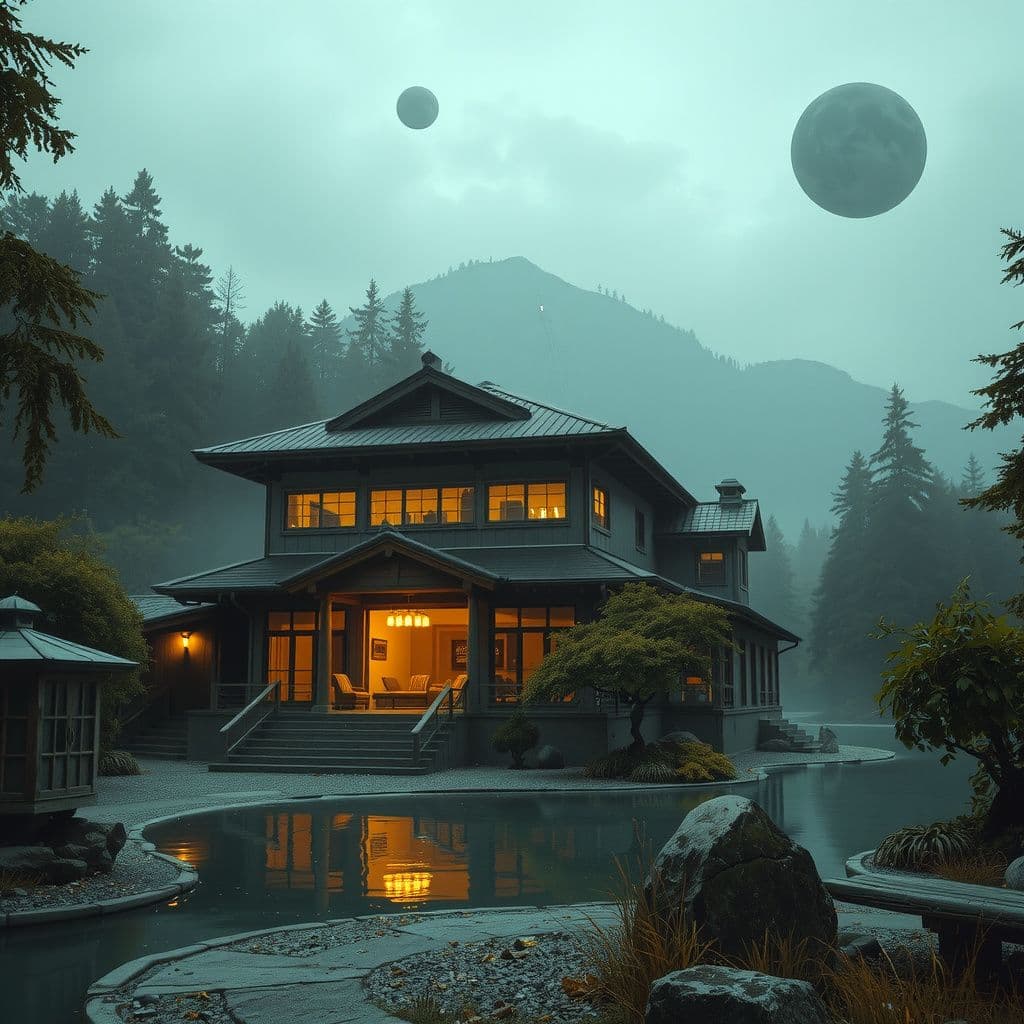
Abandoned resort and Hot springs
The dream took place at my old house in Cedar Park. Kat, Catherine, and I were there waiting for my parents to arrive for some reason. The house itself was empty, but we were spending time there together. Catherine and I were involved in a romantic relationship again, though it was secret because we were both women. There was also tension surrounding the relationship because we had dated in real life in the past. Even though we were adults in the dream, many of the emotions between us felt like they came from when we were in high school—uncertain, insecure, and immature. Part of me wanted to reconnect with her, but another part knew we had already been through this once before. Kat was present as well, although our relationship felt strained, much like it is in real life. We don't really have a relationship anymore, but in the dream she remained part of the group. The backyard was completely different from my real childhood home. Instead of a neighborhood, there was a large wooded area stretching behind the house. Hidden among the trees were old houses and buildings that looked ancient and abandoned. As we explored, we came to a beautiful river or large pond. Across the crystal-clear water sat another abandoned building, and Catherine and I decided we wanted to investigate it. I pulled out my folding kayak, the same type I own in real life. It unfolded from a flat, briefcase-like shape into a full kayak using a series of folds and snaps. Kat stayed behind while Catherine and I crossed the water. When we arrived, we discovered what appeared to be an abandoned resort. There was an old theater, a hotel, and something that resembled a Japanese bathhouse or onsen. At first, everything looked deserted and forgotten. However, the longer we stayed, the more alive the place became. We began finding little gifts hidden throughout the property. There were beautifully arranged Japanese meal sets, tiny desserts, and small treasures left behind as though someone had been expecting us. We started eating the food and exploring deeper into the buildings. Gradually, the entire place transformed. What had initially looked abandoned began to resemble something straight out of a Studio Ghibli film, especially Spirited Away. The bathhouse became luxurious and inviting, workers began appearing, and the atmosphere felt magical. At some point, Catherine and I started working there. The place felt wonderful, and we became increasingly attached to it. We enjoyed the hot springs, the theater, and the growing sense that we had discovered a hidden world. Kat eventually returned and tried to convince us to leave. She insisted that the resort was actually abandoned and scheduled to be demolished soon. From her perspective, it was still nothing more than a haunted ruin. Catherine and I, however, saw something entirely different. To us, it looked beautiful, alive, and full of possibility. Over time, we realized something wasn't right. The more we consumed the food and participated in the resort's activities, the stronger our attachment became. We were also required to sell products for the hotel, and somehow that obligation tied us even more closely to the place. A manager kept encouraging us to stay, and despite our growing suspicions, part of us genuinely wanted to remain there. Eventually, we discovered that we were being manipulated. The magic of the resort was disguising what it truly was. Beneath the illusion, it was still an abandoned set of ruins. The more attached we became, the harder it was to leave. The most frightening realization was that if the resort was demolished while we remained connected to it, we would somehow be destroyed along with it. From that point forward, the dream became about escape. We hid throughout the theater and other buildings while one of the workers searched for us. Somehow, Catherine and I could transform ourselves into inanimate objects, allowing us to blend into the scenery whenever he came looking. The worker seemed to be trying to sell products, but there was also a sense that he was trying to sell us as well, as though we had become part of the resort's inventory. As we searched for a way out, the river remained visible. Beyond it, I could still see my house in the distance. It wasn't far away at all. It felt like I was still standing in my own backyard, yet somehow that familiar world had become unreachable. The water was one of the most vivid parts of the dream. It was crystal clear, cold, and beautiful. I remember swimming through it and feeling completely at peace. Eventually, Catherine and I attempted to escape. I used my kayak again while she stayed behind temporarily to distract the worker and give me time to get away. I never found out whether she made it out herself. The dream implied that she probably would, but I woke up before I could know for sure. What stayed with me most was the feeling at the end. Even after realizing the resort was manipulating us, I still didn't want to leave. I loved the bathhouse, the theater, the hot springs, and the sense of wonder the place provided. I knew it wasn't good for me and that it was built on an illusion, yet part of me still wanted to stay. The dream ended with me in the water, trying to make my way back toward home while looking over my shoulder at a magical world that I knew I had to leave behind.
✨ AI Generated Interpretation
Your dream stages a return to an old, familiar place — the house in Cedar Park — as if your psyche has come home to look through the rooms of earlier selfhood. That house being empty while you wait for your parents suggests a safe container for processing family dynamics and earlier identity formations without direct confrontation. The presence of Catherine and the rekindled secret romance pulls up a repeating emotional pattern: attraction mixed with shame or secrecy, and the feeling that parts of you are still operating from a high-school script. Psychologically this reads like a replay of unresolved emotional material: the heart wants reconnection, but memory and experience remind you that the story has been written already and walking it again may reproduce the same uncertainty and insecurity. The backyard’s transformation into woods and abandoned buildings opens the dream into archetypal territory. Jung would call this the threshold to the unconscious — familiar ground giving way to old, forgotten houses like neglected rooms of your inner world. The river and the kayak are classic liminal symbols: water as feeling, depth, and change; the kayak as your current capacity to navigate emotion and to carry yourself between states. Crossing to the resort with Catherine suggests a joint exploration of a seductive, otherworldly part of the psyche — a place that promises renewal and enchantment (the onsen, the theater, the Ghibli-like magic), and that also offers nourishment in the form of hidden gifts and food. Those delights feel healing and attractive, which helps explain why you stayed even after suspicion arose. The resort’s slow reveal — from abandoned ruin to lush bathhouse and back to an illusion — maps onto a clear psychological tension between enchantment and exploitation. On one hand the place embodies imagination, ritual, and sensual restoration; on the other it becomes a binding mechanism: selling products, becoming part of the inventory, and the threat of demolition that would destroy you if you’re still attached. Freudian and modern perspectives might call this a repetition compulsion or a relational pattern in which closeness comes with losing autonomy. The worker who searches and the pressure to perform and sell suggest external forces (people, roles, social expectations) that would like to turn you into a commodity — or into a role that supports an illusion rather than your living self. Your ability with Catherine to transform into objects and hide speaks to how you’ve learned protective strategies — dissociation, blending in, or taking on a function to avoid being seen fully. That the water nonetheless offers peace is important: it shows a part of you that finds real sanctuary in feeling and movement rather than in staged enchantment. Choosing to kayak away — and the unresolved uncertainty about Catherine’s fate — captures the bittersweet work of disentangling from something alluring but unsafe. You’re practicing agency: you can cross, you can carry yourself back toward home, and yet you look back with longing. That ambivalence is honest and human; leaving an enchanting but illusory environment often involves grief for what felt nourishing even if it wasn’t ultimately sustaining. Taken together, this dream is about boundary and belonging, about distinguishing between genuine nourishment and captivating illusion, and about reclaiming movement through your inner life. It invites compassion for the part of you that doesn’t want to leave the bathhouse — that part has been comforted and delighted — while also clarifying that remaining risks being consumed by a version of yourself that is dependent on external validation or roles. In waking life this might relate to relationships (old romantic patterns with Catherine), friendships that have gone quiet (Kat), or any situation where work, identity, or social expectation asks you to sell a part of yourself. The dream encourages you to honor the enchantment but to trust your capacity to cross back over the water, to bring the lessons and the real nourishment with you, and to make choices that protect your autonomy even as you grieve what you leave behind.
See something concerning?
Report dreams that may violate our public sharing rules.
Review our Community Guidelines for details on what can appear publicly on the site.