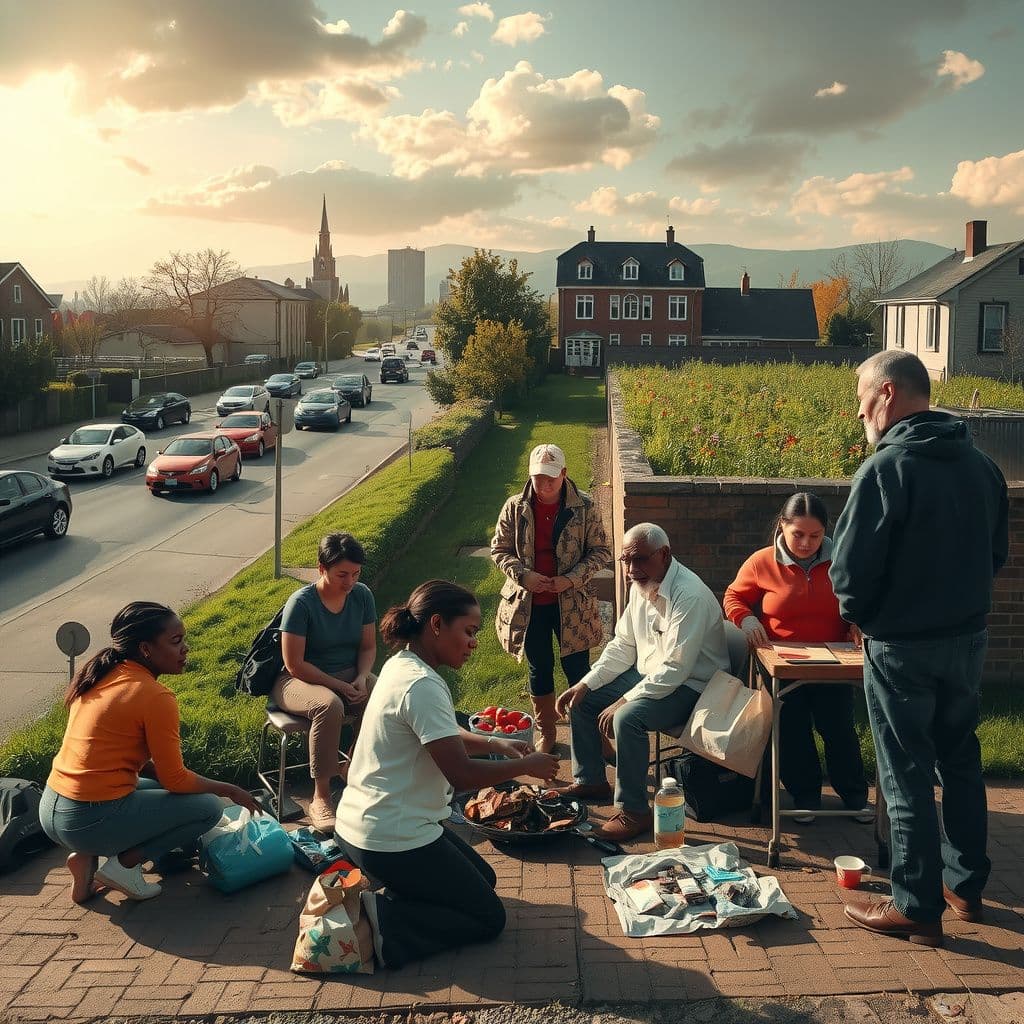
Homeless shelter project
In this dream, I was not myself but a random character living in a city with a large homeless population. Along with several others, I purchased a property to create a homeless shelter. The goal was to provide a safe place for people to stay, including those struggling with drug use, while also trying to accommodate different groups such as women, families, and children. Much of the dream focused on preparing the shelter to open. We were constantly trying to figure out how to provide meals and basic services with a very small kitchen and almost no staff. People from the streets would freely move throughout the building while we worked, creating a sense that we had good intentions but lacked the structure and personnel needed to keep everyone safe and supported. Later, the shelter moved to a larger rural property with open land and a garden. While there was more space, it became harder for people to access the facility. The operation began to resemble a nursing home or long-term care center, but we still lacked trained staff, especially medical personnel, and it felt like we were attempting to provide care that we were not fully equipped to handle. At some point, a friend brings in his fiance to help work. He basically showed up and made her do a lot of weird projects that I could tell made her uncomfortable. He would openly be very criticizing of her job duties and how well she was maintaining. So it created some strange tension in the facility being around them. It seemed he became just kind of a asshole from that point on, that I didn't want to talk to anymore. I tried to hang out more with his fiance to keep him away. Near the end of the dream, an inspector arrived, and I felt strongly that we were not truly ready to open. Despite our efforts to reorganize living spaces, improve common areas, and establish meal services, the overall feeling was that the shelter had grown beyond our capabilities. The dream ended with a sense that what we really needed was a professional support system and around-the-clock medical staff to properly care for the people we wanted to help. Unfortunately, it seemed that my friends started to care more about money and other things than actually helping people properly. This was more because we couldn't afford to maintain services--so people started cutting corners with expenses to save money which only made the place more chaotic .
✨ AI Generated Interpretation
This dream reads like a compassionate, anxious rehearsal for roles you may be stepping into or considering in waking life: caregiver, organizer, or someone trying to hold a complicated, vulnerable system together. The city with a large homeless population and your group’s earnest plan to buy a property to create a shelter feel archetypal — you are taking on the work of containing and caring for what society (or your psyche) tends to push to the margins. That impulse is noble, but the dream centers on the strain of intention without structure: a small kitchen, almost no staff, people freely moving through the building. Emotionally the scene carries both deep empathy and a gnawing sense of inadequacy — a classic tension between the desire to help and the dawning realization that goodwill alone is not enough. Seen through a Jungian lens, the homeless population and the makeshift shelter can stand for shadow material — neglected, disowned parts of the self that need attention, structure, and nourishment. The cramped kitchen is a strong image of limited resources: nourishment is intended but constrained. The people from the streets moving through the space without boundaries suggests blurred inner limits or overwhelming demands on your emotional energy; compassion without containment invites burnout. Freudian themes might point to the kitchen as a symbol of basic care and oral nourishment, and its small size speaks to feels of scarcity or an inability to provide full, sustained care. Modern dream theory would emphasize the literal problem-solving nature of the dream: your mind is trying out solutions to complex caretaking problems while also signaling practical limits. The move to a larger rural property with a garden introduces a different set of symbolic tensions. On one hand, the garden evokes growth, recovery, and a hope for slower, regenerative work; on the other, the rural isolation makes the shelter harder to access. Psychologically this could mirror a desire to retreat to a safer, calmer space while worrying that that same retreat makes you out of reach to those who need you — or makes your resources less effective. The shift toward something resembling a long-term care facility, combined with the lack of trained staff and medical personnel, amplifies the theme of overreach: wanting to hold long-term healing without the infrastructure for it. The inspector’s arrival near the end functions like an inner tribunal or superego figure — a confrontation with standards, reality checks, and the fear of being exposed as unprepared or incompetent. The interpersonal drama with your friend and his fiancée layers in concerns about boundary violations, power dynamics, and becoming entangled in someone else’s dysfunction. His turn into a harsh critic and the fiancée’s discomfort highlight the appearance of an externalized inner critic or interpersonal strain that undermines the caregiving project. Your impulse to spend time with her to shield her from his negativity speaks to protector archetypes in you — but also to the emotional labor you may be taking on to manage others’ relationships and tensions. The later focus on money, cutting corners, and prioritizing survival over care brings forward a pragmatic anxiety: values conflict (helping vs. sustaining the project financially) and the painful realization that good intentions can be overtaken by practical constraints. Overall the dream seems to be working through two converging messages: a strong, ethically motivated desire to help and the sober recognition of limits — both personal and systemic. It asks you to consider where compassion becomes enabling or unsafe without structure, and it invites reflection on when to recruit professional help, set boundaries, or scale back ambitions to match resources. Rather than a failure, the dream can be read as an integrative warning: it urges you to honor your impulse to care while also building realistic supports — clearer roles, trained partners, sustainable funding, and emotional boundaries. If you’re wrestling with a real-life project, relationship strain, or an overload of responsibility, this dream offers compassionate permission to re-evaluate scope and to seek outside help rather than carrying everything alone.
See something concerning?
Report dreams that may violate our public sharing rules.
Review our Community Guidelines for details on what can appear publicly on the site.